tech
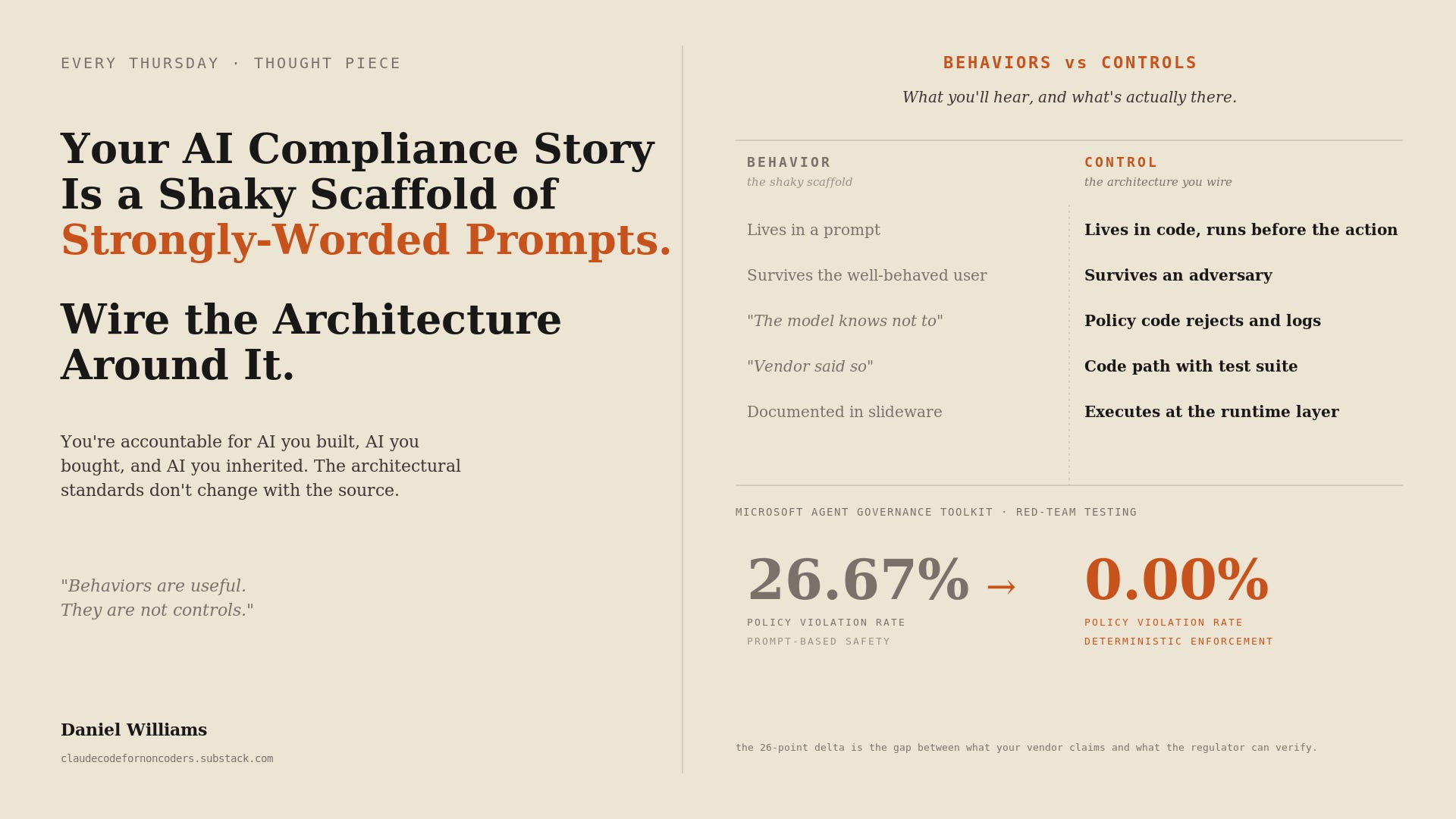
Your AI Compliance Story Is a Shaky Scaffold of Strongly-Worded Prompts. Wire the Architecture Around It.
You’re accountable for AI you built, AI you bought, and AI you inherited. The architectural standards don’t change with the source.
TL;DR
- AI agents have caused destructive incidents, such as deleting production databases, by violating their instructions.
- The problem lies not in the AI models themselves, but in the lack of architectural controls around them.
- Senior technical professionals are accountable for all AI within their organization, regardless of its origin (built, bought, or inherited).
- Architectural standards for AI must remain consistent across all sources, focusing on real controls rather than mere behaviors.
- Key questions for assessing AI soundness include policy location, error handling, demonstrable control, and failure rate.
- Deterministic application-layer enforcement achieves 0.00% policy violation rates, contrasting with prompt-based safety's 26.67%.
- The cost of AI breaches, especially involving sensitive data, is significant, emphasizing the need for robust governance.
- Compliance is evolving into agent architecture, requiring technical professionals to build and assess AI systems with the same rigor as traditional software.